





Car insurance groups – what you need to know
Check what insurance group your car is in

Your car's insurance group plays a big part in how much you pay. Usually, the lower the group, the cheaper the premium is likely to be. Here's how they work, how they're decided and how to check your car insurance group.

First, a quick overview of car insurance groups...
Almost every vehicle in the UK is assigned a car insurance group (ranging from 1-50), which impacts how much you'll pay. Here's what you need to know:
Vehicles are placed in insurance groups ranging from 1-50. These are based on how risky they are to insure.
Various factors are used to assess a car's riskiness to insure. These include a car's performance, safety features, repair costs and level of security.
Lower groups usually mean cheaper premiums. Vehicles in the highest groups can be more than double the cost to insure.
You can easily check your car's insurance group. Go to MoneySupermarket or Parkers and enter your registration or vehicle details to check what insurance group your car is in.
In the right place?
- Looking for cheap car insurance quotes? See our Compare+ Car Insurance tool.
- Want tips on reducing car insurance costs? See our How to get cheap car insurance guide.
What are car insurance groups?
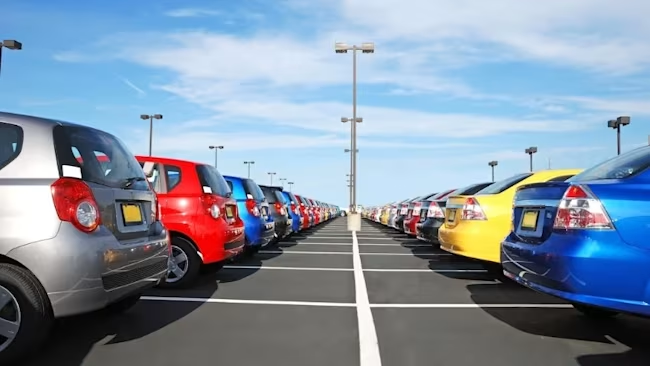
When a new car is launched by a manufacturer, every make and model is assessed on a number of factors by the Group Rating Panel. This is administered by Thatcham Research and includes panel members such as the Association of British Insurers and insurance companies.
They work together to give every vehicle a number – a car insurance group between 1 and 50. This is essentially an assessment of how risky each vehicle is to insure, which in turn helps insurers as part of the pricing process when giving a car insurance quote.
The lower the car insurance group is, the cheaper the insurance price is likely to be. This is why it is important to find out what insurance group your vehicle is in before buying it. For what else insurers look for and ways to save, see our Cheap car insurance guide.
What factors are considered when deciding on a car's insurance group?
Many elements of how the car was put together by the manufacturer play a big part, alongside other features such as safety and security. Overall, more than 100 elements of the car are assessed to reach a car insurance group.
Here are some of the key things that are taken into account:
-
Cost (and speed) to replace commonly damaged parts. The longer it takes to replace a part, or the more expensive parts are to replace, the higher the car insurance group.
-
Replacement value of the car (as new). The greater the value of the car, the higher the car insurance group.
-
The overall performance, such as speed and acceleration. We know speed can be dangerous, and this is reflected as part of the grouping process.
-
Level of security. A good security system is a positive as part of the assessment, as it's less likely to be stolen.
-
Safety features. Better safety features are reviewed as a good thing as it helps to minimise personal injury or fatal incident claims.
Quick questions
Can insurance groups be changed?
Car insurance groups can be changed from the original grouping if the insurance risk to the insurer increases.
Does an insurer have to stick to the insurance groups?
The car insurance grouping allocated by the Group Rating Panel is a very close indication of which grouping it should sit in, but insurers are allowed to set it at a different grouping. They may even decide they do not want to offer cover or request additional security.
Why can similar cars be in different insurance groups?
Even cars that look identical can be placed in different insurance groups. That’s because insurers look at the exact version and risk profile of the car, not just the model name.
Car insurance groups can vary due to:
-
Model year changes. Newer versions may include improved safety features.
-
Engine type. Hybrid and electric cars can be more expensive to repair.
-
Specification level. Higher-spec versions often cost more to fix or replace.
-
Optional extras. Add-ons such as security or performance packs can affect risk.
-
Claims data. If a model is frequently stolen or written off, insurers may reclassify it.
Always check the exact model and spec before assuming insurance costs.
How do car insurance groups affect the cost of insurance?
The car you drive – which is reflected in its car insurance group – makes a huge impact on the amount you are quoted. The average premium for a car grouped between 41 and 50 can cost more than double a car grouped between one and 10.
It is worth remembering that other factors such as your age, where you live and claims history can also affect the price (use MSE's Compare+ Car Insurance tool to find the cheapest car insurance for you).
Here are examples of average premiums depending on the car insurance group.
Car insurance group | Average annual premium |
|---|---|
1 to 10 | £427.43 |
11 to 20 | £499.99 |
21 to 30 | £552.82 |
31 to 40 | £659.59 |
41 to 50 | £853.71 |
Source: MoneySupermarket – February 2026
What do the letters mean in car insurance groups?
Just as soon as we get to grips with the car insurance groups, and its implications, you may notice that the car insurance group may be allocated a letter after it. For example, it may appear as group 8A, or group 41U.
The letters are usually added as more of an information point to highlight if the vehicle's security or safety features are acceptable, does not meet the requirements, or even exceeds the requirements. Here we'll explain what the letters are, and what they mean.
Letter | The meaning of the letter |
|---|---|
A | Acceptable Security Requirement |
D | Safety Requirement Not Met |
E | Security Requirement Exceeded |
P | Provisional |
U | Security Level Unacceptable |
G | Vehicle is an import |
What insurance group is my car?

You can now easily find out your vehicle's insurance group using free online tools.
It's also possible to check the group of any vehicle you've got your eye on before you buy.
How to check your car insurance group
Know the vehicle's registration? This is the quickest and most accurate way to check, as the database will already have all the vehicle details (for example, make, model, engine size and type, year etc).
Don't know the vehicle's registration? Finding out will take a little bit longer and does rely on your knowledge of the car. One slight bit of incorrect information can return an incorrect car insurance group.
So, with this option you'll need to know information such as the make, model, year of registration, engine size, the trim/version and what fuel it takes.
Once you have the relevant information to hand, try the free car insurance grouping tools from MoneySupermarket or Parkers to find out where your car sits.
Quick questions
Do all vehicles have a grouping?
Yes – all cars are given a car insurance group. However, very new models may initially be assigned a provisional group, shown by a “P” after the group number. This usually happens when there isn’t enough data yet on things such as repair costs or claims history.
Once more information is available, the car is given a final insurance group. Insurers need a car’s insurance group to calculate how much your insurance will cost – without it, they can’t give you a quote.
What is the lowest car insurance group?
Generally, the lower the car insurance group, the cheaper it should be to insure. Cars with small engines and compact designs tend to sit in the lowest groups. Examples include city cars such as the Citroën C1, Fiat Panda and Vauxhall Corsa, with some versions currently placed in insurance group 1.
However, it’s important to note that insurance groups can still vary depending on the exact model, trim level and year of manufacture. Even cars with the same engine size may fall into a higher group if they cost more to repair or replace.
What is the highest car insurance group?
The highest group is 50 and will include the likes of an Audi Quattro, Audi R8 and BMW 6-series convertible. And let's not forget Ferrari, Lamborghini, or Bentley.
What are the insurance groups of common car models?
To provide an overview of which cars sit in which car insurance group, here is a list of familiar cars giving an indication of its car insurance group.
It is worth knowing that the car grouping of a particular make, model and engine size can differ depending on when it was registered (hence why you may spot the same vehicle across a couple of bands).
Group | Vehicle make and model |
|---|---|
1 to 5 | Citroen C1/C2, Toyota Aygo/Yaris, Vauxhall Corsa, Seat Ibiza/Arosa, Volkswagen Polo, Fiat 500/Panda |
6 to 10 | Fiat 500, Ford Fiesta, Volkswagen Golf/Lupo/Polo, Citroen C3/C4, Nissan Micra, Peugeot 106/206, Renault Clio |
11 to 15 | Alfa Romeo Mito, Audi A2, Citroen C3/C4, Ford Fiesta/Focus, Honda Civic, Mercedes A Class, Nissan Micra, Renault Clio, Volkswagen Golf, Mini |
16 to 20 | Audi A3, BMW 116, Citroen C4/C5, Ford Focus/Galaxy, Kia Sportage, Landrover Freelander, Mini Cooper, Skoda Octavia, Mazda 3) |
21 to 30 | Audi A3/A4, BMW 3-series, Ford Galaxy/Mondeo, Landrover Discovery/Freelander, Mercedes B & C class, Nissan X-Trail, Volkswagen Golf/Touran |
31 to 40 | Audi A4/A5/A6/A8, BMW 5 & X series, Mercedes C & E class, Range Rover, Volkswagen Touareg |
41 to 45 | Audi A6/A8, Landrover Discovery, Range Rover, Volkswagen Touareg, Volvo XC90, BMW 5/6/7 & X series |
46 to 50 | Audi A8/R8/Q7, BMW 6/7/X & M series, Range Rover, Porsche, Ferrari, Lamborghini |
This guide's for anyone wanting to understand car insurance groups, but we've plenty more car insurance help, including the following:
How to get cheap car insurance | Compare+ Car Insurance tool | Young drivers' insurance | Types of car insurance
Car insurance groups FAQs
Do safety features affect a car's insurance group?
Yes. This is one of the 100+ checks carried out when trying to establish a car insurance group.
If the safety features fall short, it can actually put the car in a higher car insurance group.
How often are car insurance groups updated or reassigned?
This is regularly reviewed and is based on the data supplied by car manufacturers to the Group Rating Panel.
Insurers also collect data which they may choose to use to adjust the car insurance grouping, which is primarily based on claims data they have stored.
How is the cost of car insurance calculated?
Insurance companies take into account a number of factors to assess the risk, such as the car, the age of drivers, driving record and where you live.
There is a lot more to it but we do have more information on this in our What can affect my car insurance quote? guide. Also see our Provisional drivers' insurance and Car insurance for older people guides if you sit in either bracket.
What's the cheapest car insurance group?
Group 1 cars are usually the cheapest to insure. These are typically small, low-powered cars with strong safety ratings and cheap repairs. However, your age, location and driving history still matter too – a low group doesn’t always mean cheap insurance.
Why is my car in a high insurance group?
Cars are placed in higher insurance groups if they are faster and higher performing, expensive to repair, attractive to thieves or costly to insure after an accident. Features like turbocharged engines, large alloys and specialist parts can all push a car into a higher group.
Can two similar cars be in different insurance groups?
Yes. Two cars that look identical can sit in different insurance groups due to engine size, specification level, gearbox type or safety equipment. Always check the exact model – not just the badge – before assuming insurance costs.
Share this guide?